How Mortar and Foam Secure Ridge and Hip Tiles
Mortar and foam hold your ridge and hip tiles down. Here's how each method works, why tiles loosen in Laguna Niguel, and what re-securing costs in 2026.
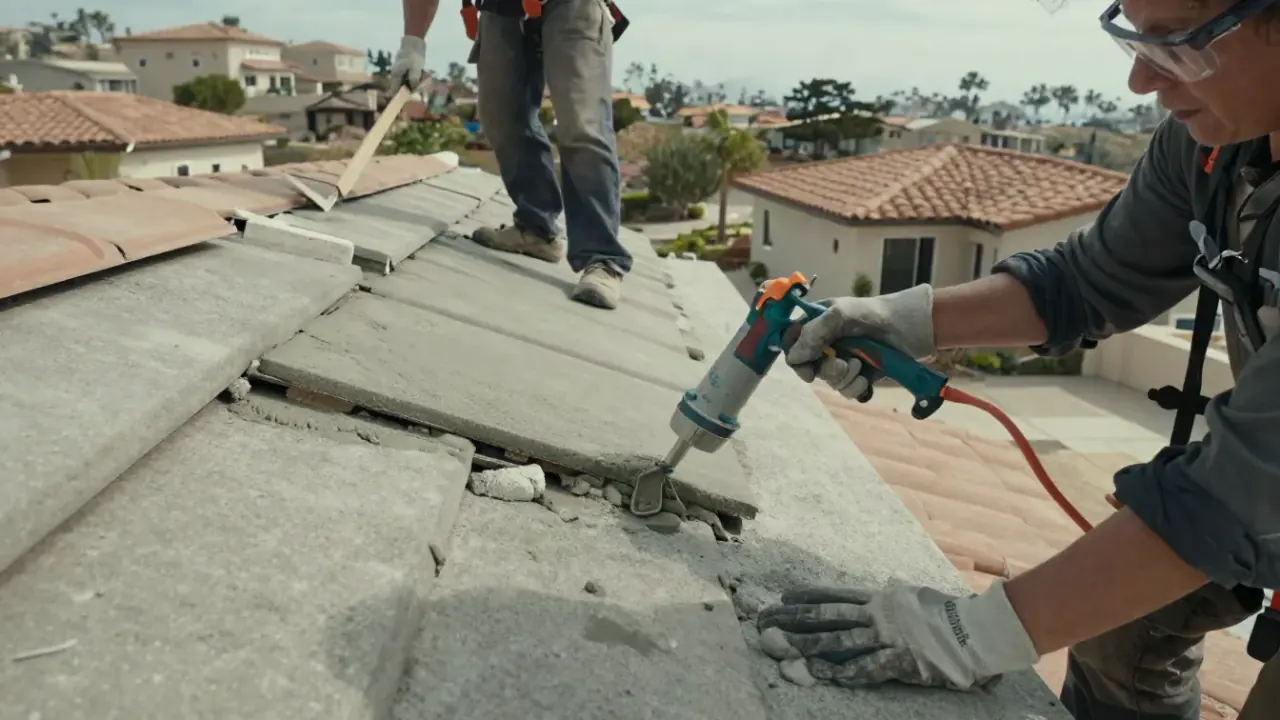
Mortar and foam secure ridge and hip tiles by bonding each tile to the ones beside it and to the roof structure underneath, so wind uplift and gravity can't peel them off the peak or the corners. Mortar is a sand-and-cement bed that cures rock-hard and has held California tile roofs for a century; foam is a two-part polyurethane adhesive that expands, grips in minutes, and flexes with the roof instead of cracking. Which one is right for your Laguna Niguel home depends on your tile profile, your roof pitch, and how much movement the ridge line is seeing.
We re-secure ridge and hip tiles across Laguna Niguel every week, and the failures we see are almost never random. They follow patterns - a certain slope, a certain age of mortar, a certain wind direction coming off the canyon. Below we break down how each method actually works, why tiles let go here, and what a proper re-securing job looks like in 2026.
How Mortar and Foam Secure Ridge and Hip Tiles
Ridge tiles cap the peak of the roof; hip tiles run down the sloping corners where two roof planes meet. Both sit on top of the field tiles and both take the full force of wind, sun, and thermal movement, which is why they loosen before anything else on the roof. The securing method has one job: hold each cap tile tight to the roof and to its neighbours so water can't get underneath and wind can't lift it.
There are two ways we do that. The traditional method is a bed of mortar troweled onto the ridge or hip, with the tile pressed into it and the joints pointed smooth. The modern method is a bead of expanding polyurethane foam applied along the same line, with the tile set into it and mechanically fastened at the same time. Both work. Neither works if the prep is skipped.
Every re-securing job we run follows the same sequence, and this is the part most homeowners never see:
- Remove the loose or cracked cap tiles and bag them for reuse where possible.
- Scrape out old mortar or foam and clear the ridge board or hip rafter underneath.
- Check the underlayment at the ridge - if it's torn or baked out, it gets replaced before anything goes back down.
- Re-bed the tiles in mortar or foam, and drive fasteners into every third or fourth tile.
- Point the joints, clean the line, and water-test the ridge before we pack up.
If the underlayment under the ridge has failed, re-securing the tiles alone won't stop a leak. That's a separate repair, and we handle it as Tile Roof Underlayment Replacement Laguna Niguel CA when the felt or membrane has reached the end of its life.
Why Ridge and Hip Tiles Come Loose in Laguna Niguel
Ridge tiles come loose in Laguna Niguel because the same three forces hit them every year: afternoon sun that pushes surface temperatures past 140°F, marine air that works into hairline cracks, and Santa Ana winds that gust through the canyons at 40 to 60 mph. Mortar that has been on a roof for 20-plus years has already lost most of its grip by the time you notice a tile sitting crooked.
Thermal cycling is the biggest driver. A tile roof in Laguna Niguel expands and contracts roughly once a day, every day, for decades. Mortar is rigid - it doesn't stretch, so it cracks. Once a crack opens at a ridge joint, water gets in, the crack widens through the next cold night, and eventually the tile is held on by nothing but gravity and habit.
Wind does the rest. The ridge is the highest point on the roof and takes the highest uplift pressure. A single missing or lifted cap tile on the windward side of a hip is enough to start a chain reaction - the next tile loses its neighbour's support and lifts too. We see this most often on exposed ridgelines in Niguel Summit Tile Roof Repair and along the upper streets of Bear Brand Ranch Tile Roof Repair, where the elevation and canyon exposure combine.
Age matters too. Most of the tile roofs we re-secure in Laguna Niguel were installed between the late 1980s and the early 2000s. The tiles themselves are fine - clay and concrete tile last 50 years or more. The mortar holding them down is not, and that's the part that fails first.
How Mortar Secures Ridge and Hip Tiles
Mortar secures ridge and hip tiles by forming a rigid cement bed that locks each cap tile to the ridge board and to its neighbours, creating a continuous, water-shedding cap over the peak. A proper mortar mix for tile roofing is roughly three parts sand to one part cement, sometimes with a bonding additive, troweled to a bed about 1 to 1.5 inches thick under each tile.
The strength of a mortar job comes from three things: the mix, the cure, and the mechanical fastening. We bed each tile in fresh mortar, press it down until it seats, then drive a corrosion-resistant screw or nail through the tile's pre-drilled hole into the ridge board. The mortar holds the tile in place while the fastener keeps it there if the mortar ever fails. That combination is what makes a mortar ridge last 20 to 30 years in this climate.
Mortar has real advantages. It looks traditional, it matches the original construction on most Laguna Niguel homes, and it can be re-pointed - a repair where we grind out the cracked joints and pack in fresh mortar - without pulling the tiles off. On a roof where the tiles are still seated and only the joints have failed, re-pointing is the cheapest correct fix.
The downside is rigidity. Mortar cracks. When it does, the crack runs along the joint and lets water in. That's why we always pair a mortar re-bed with a check of the flashing at the ridge ends - a cracked mortar joint and a lifted Tile Roof Flashing Repair Laguna Niguel CA are the two most common sources of ridge-line leaks we find.
How Foam Secures Ridge and Hip Tiles
Foam secures ridge and hip tiles by expanding into the gaps between the tile and the ridge, then curing into a flexible adhesive that grips the tile across its full underside instead of just at the joint. The foam we use is a two-part polyurethane that sets in about 10 to 15 minutes and reaches full strength within 24 hours.
Foam's advantage is movement. It flexes with the roof instead of cracking, so it handles the daily thermal cycle that destroys mortar. It also bonds to almost anything - clay, concrete, old mortar, and the ridge board itself - which makes it useful on re-work where the original bed is uneven. On a hip line with a lot of small cuts and awkward angles, foam is faster and cleaner than troweling mortar into tight spaces.
Foam has limits. It's not structural on its own. Every tile we set in foam also gets a mechanical fastener, because foam alone can soften in extreme heat over many years. And foam is unforgiving of bad prep - if the ridge is dusty or wet when it's applied, it won't bond, and you'll be back on the roof in two years. We always wire-brush the ridge board and confirm it's dry before we open a foam cartridge.
For a roof where the tiles are sound but the mortar bed has failed across the whole ridge, foam re-securing is usually the faster path. For a roof being restored to its original look, mortar is the better match. If the whole roof is at the end of its service life, neither is the right answer - that's a Tile Roof Re-Roofing Laguna Niguel CA conversation, and we'll tell you so rather than sell you a patch.
Mortar vs Foam for Ridge Tiles in Laguna Niguel
Mortar wins on longevity and appearance; foam wins on speed, flexibility, and performance on awkward hips. In Laguna Niguel's climate, both are viable, and the right choice comes down to the specific roof rather than a blanket rule.
Here's how we decide:
- Mortar - best when the original ridge is mortar, the tiles are being reused, and the homeowner wants the roof to look untouched. Expect 20 to 30 years of service with a re-point at year 12 to 15.
- Foam - best on hips with tight cuts, on re-work where the old bed is uneven, and on roofs where speed matters because rain is coming. Expect 15 to 25 years, with the caveat that it must be paired with fasteners.
- Hybrid - mortar bed with foam at the joints. We use this on long ridge runs where we want the traditional look but need the joints to stay flexible.
Cost is close enough that it shouldn't drive the decision. Typical 2026 pricing in Laguna Niguel runs $12 to $22 per linear foot for re-securing, whether mortar or foam. A standard 40-foot ridge line lands between $500 and $900; a full ridge-and-hip re-securing on a 2,500 sq ft home usually comes in at $1,200 to $2,400. The variables are access, how many tiles need replacing, and whether the underlayment at the ridge is still sound.
One thing we won't do is foam over a wet ridge. If we find moisture in the underlayment, we stop and fix that first. Foam traps water, and a trapped leak rots the ridge board from the inside out - a $600 repair turns into a $4,000 one.
When to Call a Professional
Call a professional when a ridge or hip tile has visibly shifted, when you can see daylight through a ridge joint, or when you find grit and mortar crumbs in the gutter after a windy night. Those are the three reliable signs that the bed has failed and the next Santa Ana wind will take the tile off.
We handle Ridge Tile Re-Securing Laguna Niguel CA as a same-week service. A technician walks the roof, photographs every ridge and hip joint, and gives you a written scope before any work starts. If the ridge is sound and only two tiles are loose, we'll tell you that and fix the two tiles. If the whole line is failing, we'll show you the photos and quote the full re-securing.
If you're not sure whether the problem is the ridge or something else, start with a Roof Inspection Laguna Niguel CA. We check the ridge, hips, valleys, flashing, and underlayment in one visit and tell you what actually needs doing - not what's easiest to sell.
Common Mistakes We See on Laguna Niguel Roofs
The most common mistake is re-securing tiles without checking the underlayment underneath. If the felt is torn at the ridge, the new mortar or foam will hold the tiles down and the leak will keep running. We pull a few cap tiles first, every time.
Other mistakes we fix regularly:
- Foam without fasteners. Foam alone is not a mechanical attachment. Every tile needs a screw or nail through it.
- Mortar mixed too dry. A dry mix doesn't bond to the tile. It crumbles within a year or two.
- Foaming over wet or dusty surfaces. No bond, no grip, no point.
- Reusing cracked tiles. A hairline crack in a ridge tile becomes a full break within a season. We replace cracked caps, not re-bed them.
- Ignoring the hips. Homeowners notice the ridge because they can see it from the street. The hips fail just as often and are harder to spot.
We also see a lot of "repairs" done from the ground with a ladder and a caulk gun. Caulk is not a ridge tile fastener. It will hold for one summer and fail the first cold night.
Frequently Asked Questions
How are ridge and hip tiles secured in Laguna Niguel?
They're secured with a mortar bed or expanding polyurethane foam, plus a mechanical fastener driven into the ridge board or hip rafter. Mortar is the traditional method and lasts 20 to 30 years here; foam is faster and more flexible and lasts 15 to 25 years. Both need proper prep to hold.
Mortar or foam for ridge tiles in Laguna Niguel CA?
Mortar if you want the original look and maximum lifespan; foam if the hips are tight, the old bed is uneven, or you need the job done quickly before rain. Cost is similar - $12 to $22 per linear foot in 2026 - so the roof's condition should drive the choice, not price.
Why do ridge tiles come loose in Laguna Niguel?
Thermal cycling, marine air, and Santa Ana winds. A Laguna Niguel roof expands and contracts daily, which cracks rigid mortar over 15 to 25 years. Once a joint cracks, wind gets under the tile and lifts it. Most failures we see are on roofs installed between the late 1980s and early 2000s.
Who re-secures ridge tiles near me in Laguna Niguel?
We do - Laguna Niguel Tile Roof Repair handles ridge and hip re-securing across Laguna Niguel and the surrounding canyons. We walk the roof, photograph every joint, and give you a written scope before work starts. Most jobs are completed in a single day.
How much does ridge tile re-securing cost in Laguna Niguel?
Typical 2026 pricing is $12 to $22 per linear foot. A 40-foot ridge runs $500 to $900; a full ridge-and-hip re-securing on a 2,500 sq ft home is usually $1,200 to $2,400. Access, tile replacement, and underlayment condition are the main variables.
Get Help with Tile Roof Repair in Laguna Niguel
If your ridge or hip tiles are shifting, cracked, or missing, we'll get them secured before the next wind event. We handle Tile Roof Repair Laguna Niguel CA across every neighbourhood in the city, from Crown Valley to the coast.
Call (949) 670-0283 and we'll schedule a roof walk-through this week.